



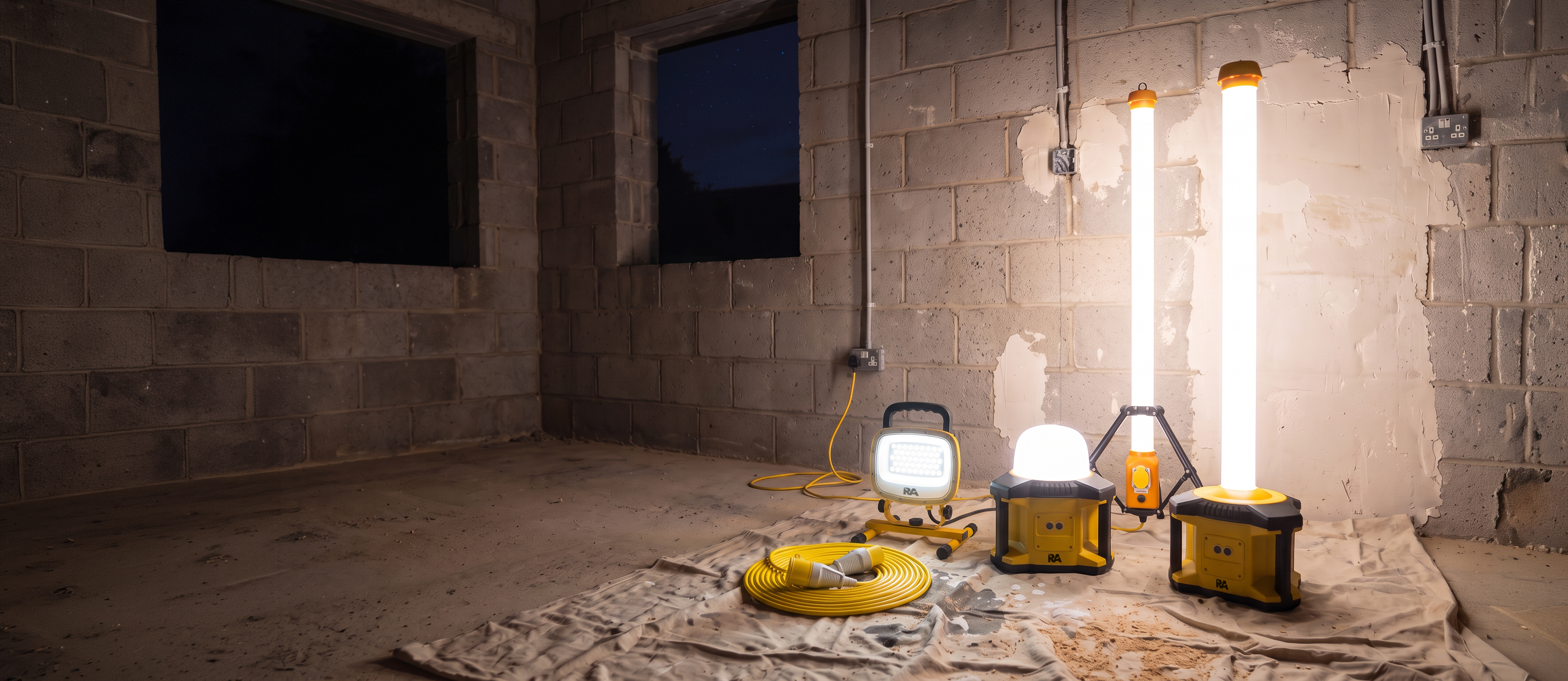
Shorter days can change the way a construction site works more than you might initially expect.
An access route that was comfortably visible in natural light during summer may be considerably darker during an early start or late-afternoon shift. Work taking place inside enclosed or partly completed buildings may also become increasingly dependent on artificial lighting as daylight reduces.
Good site lighting, however, isn't simply about adding more lights.
The Health and Safety Executive (HSE) advises that construction sites should make use of natural light where possible and provide artificial lighting where natural light is inadequate or unavailable. Its guidance also draws attention to shadows, emergency routes and situations where failure of the primary lighting could itself create a safety risk.
The starting point should therefore be the area, the task and the people using it, rather than the product.
What Does HSE Say About Construction Site Lighting?
HSE's construction guidance is quite specific about what effective site lighting needs to achieve.
People need sufficient light to carry out their work and move around safely. Where work continues outside daylight hours, or where a structure is enclosed and natural light is inadequate, artificial lighting will be required.
But brightness isn't the only consideration.
HSE highlights how shadows can conceal hazards. At the workface, that could mean making a cutting disc or drill bit more difficult to see. Elsewhere, a poorly lit stairwell or change in level could create another risk.
Artificial lighting also shouldn't affect the apparent colour or visibility of safety signs, fire extinguishers or other safety-related items.
This is also reflected in Regulation 35 of the Construction (Design and Management) Regulations 2015, which requires construction sites, approaches and traffic routes to have suitable and sufficient lighting. Natural light should be used so far as reasonably practicable, with suitable secondary lighting provided where failure of the primary artificial lighting would create a health or safety risk.
The practical question isn't therefore simply "Is this area lit?"
It is "Can the people using this area clearly see what they are doing, where they are going and the hazards around them?"
Start With the Area and the Task
There isn't one lighting format that is suitable for every part of a construction site.
A pedestrian route presents a different challenge from a detailed task at a workbench. A large internal space needs something different again from a person carrying out an inspection in a confined or changing location.
HSE's wider guidance notes that lighting needs depend on the activity taking place. It also warns about sudden changes between light and dark areas because people's eyes need time to adapt.
That makes it useful to divide the site into different lighting requirements.
Access routes may need continuous illumination along the route. Workfaces can require more concentrated task lighting. Open rooms and larger workspaces can benefit from broader distribution, while mobile workers may need additional personal lighting.
On many projects, the right solution will be a combination rather than one type of light used everywhere.
Festoon Lighting: Continuous Light Along Routes
Festoon lighting is particularly useful where illumination needs to continue along a longer route rather than originate from a single point.
Typical applications can include walkways, corridors, scaffold runs and other areas where people repeatedly move through the same space.
For example, the 22m 110V SiteForce LED Festoon Lighting, Product Code: V921-470, uses ten enclosed light modules positioned along a 22-metre length. Identifies walkways, corridors and areas beneath scaffolding among its intended applications, while the diffused lenses are designed to reduce glare.
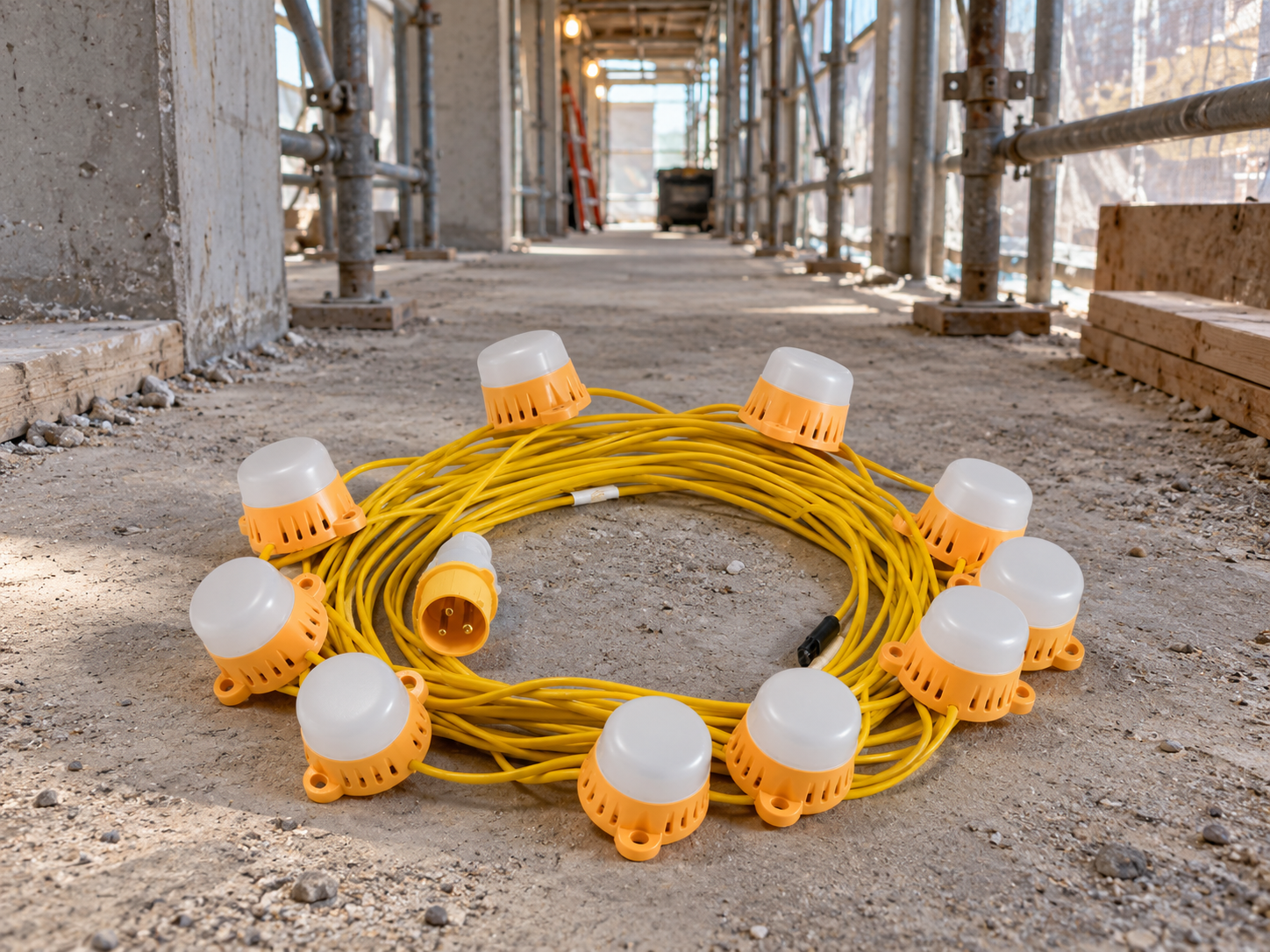
The important benefit isn't simply the output of the individual lights. It is the ability to distribute light along the area people actually need to move through.
View 22m 110V SiteForce LED Festoon Lighting
Globe Lights and Uplights: Broader Area Lighting
Larger internal spaces can present a different problem.
Using one directional floodlight may illuminate the immediate area well but leave other parts of the room noticeably darker or create heavy shadows behind equipment and materials.
Globe lights and uplights can be useful where a broader spread of light is required.
Products such as the 50W Rechargeable LED Globe Light, Product Code: V921-343, and 50W Rechargeable LED Uplight, Product Code: V921-325, are intended to provide broader-area illumination while rechargeable operation gives more flexibility over positioning.
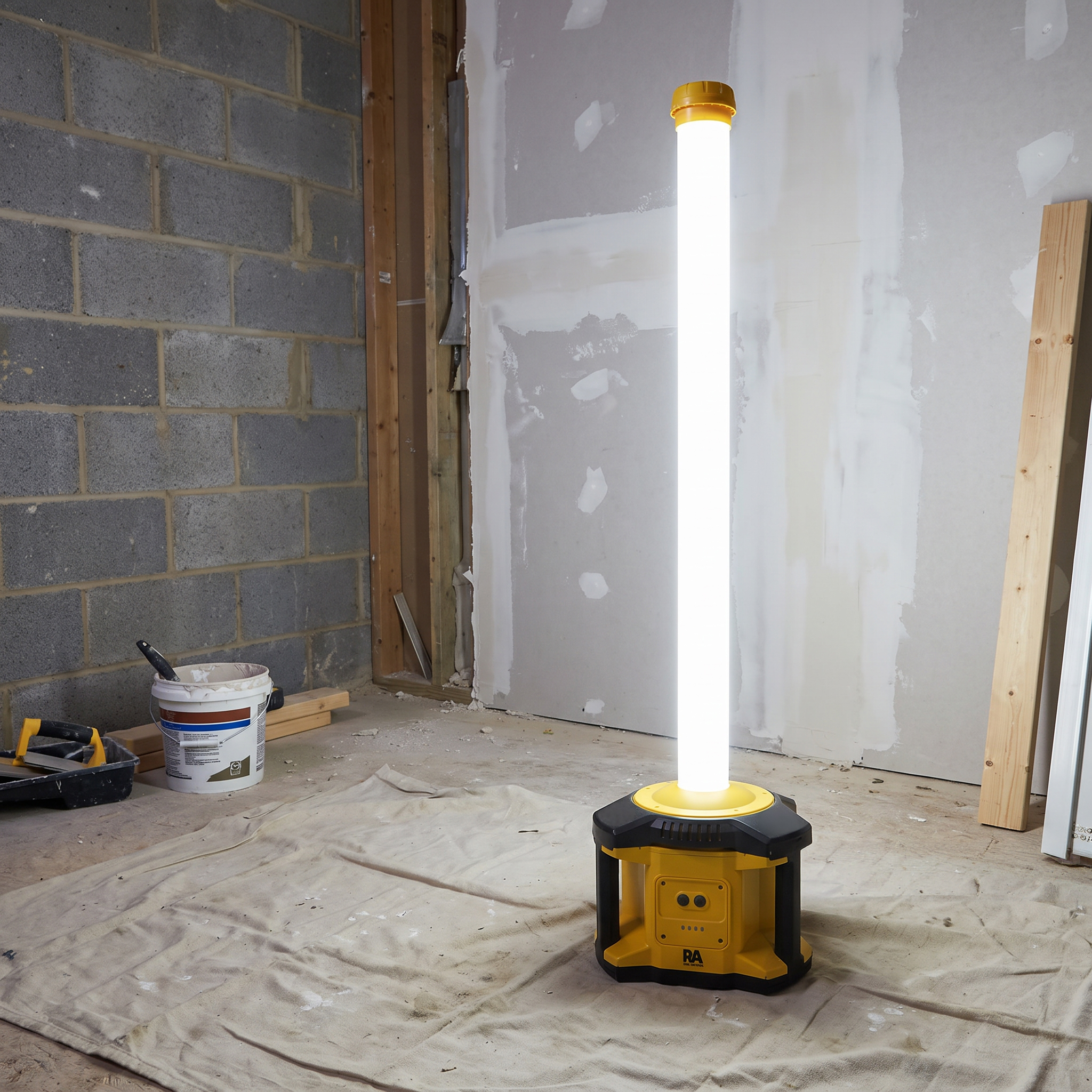
That flexibility can be valuable where running another cable across the working area would be inconvenient, although rechargeable equipment introduces another consideration: battery runtime and charging need to form part of the plan.
A rechargeable light that runs out halfway through the period it is needed isn't an effective solution simply because it removed a cable.
Portable Lighting: When the Workface Keeps Moving
Construction work rarely stays in one place for long.
As a project develops, workfaces move, rooms become enclosed and the areas requiring additional illumination change.
Portable A-frame, floor and handheld lights can therefore be useful when the light needs to follow the task.
The 20W Slimline Rechargeable Floor Flood Light, Product Code: V921-348, for example, has a folding stand and compact rechargeable design. FixFirm currently states a maximum runtime of up to ten hours, with a four-hour charge time.
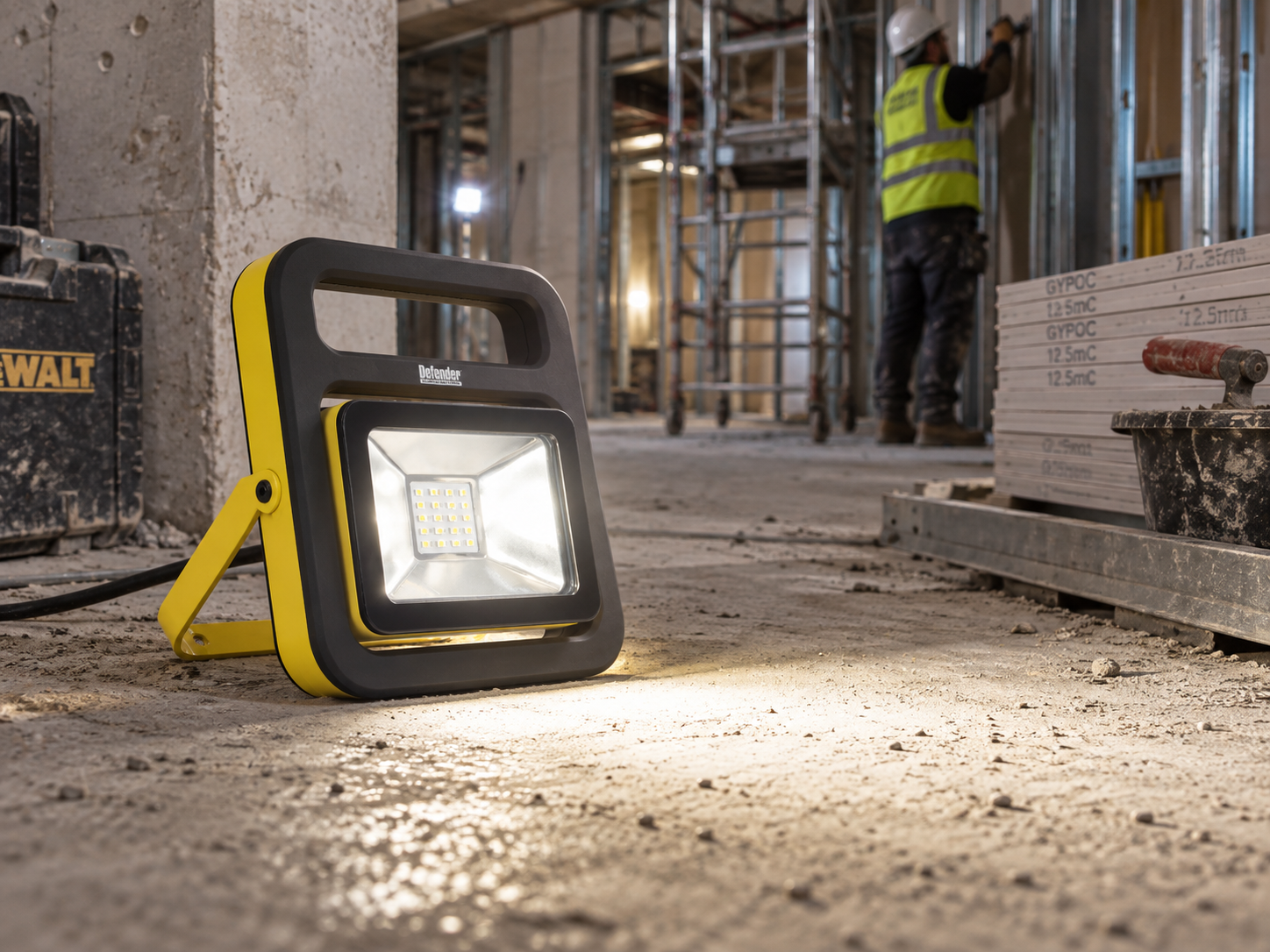
The practical benefit here is portability rather than simply light output. A rechargeable floor light can be moved with the work and positioned close to the task without necessarily introducing another trailing power lead.
That doesn't make it suitable for every situation. Where lighting needs to operate continuously for long periods, a fixed electrical supply may still be more appropriate.
View V921-348 Rechargeable Floor Flood Light
Personal Lighting Has a Different Job
Headtorches and portable torches provide another layer of site lighting.
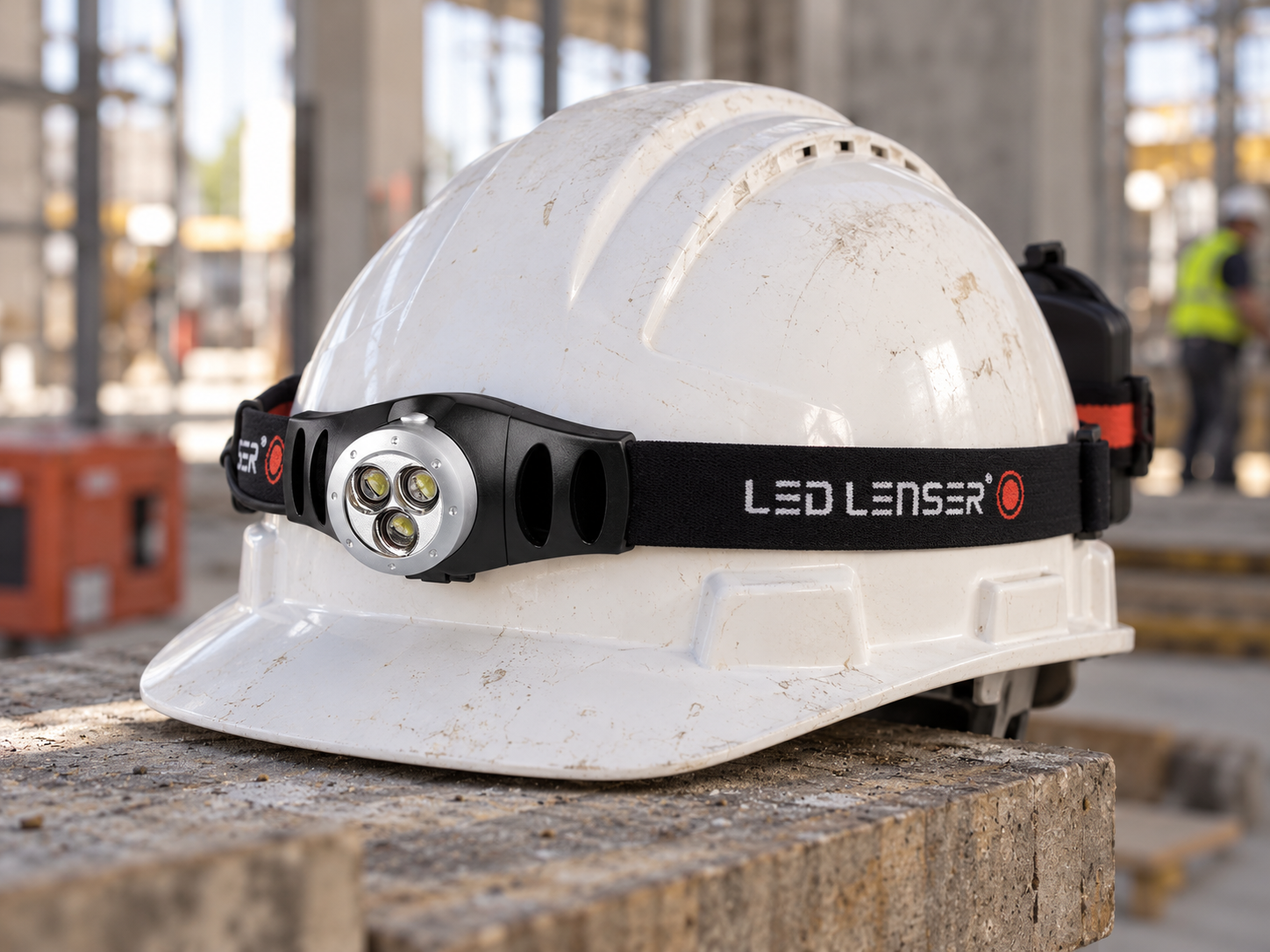
They can be useful for inspections, close work and mobile tasks where both hands need to remain available. FixFirm's lighting selection includes products such as the LEDlenser H3.2 Lightweight Dimmable Headtorch, Z182-154, and rechargeable personal-lighting options.
But there is an important distinction.
A headtorch helps the person wearing it see the immediate area in front of them. It doesn't necessarily make a walkway, room or work area adequately illuminated for everybody else.
Personal lighting should therefore generally complement properly planned area and task lighting rather than replace it.
More Light Isn't Automatically Better
Choosing the brightest available light isn't the same as designing effective lighting.
Poor positioning can create glare, heavy contrast and shadows. HSE specifically warns that shadows can conceal hazards and recommends additional lighting where necessary to illuminate those areas.
Vehicle and pedestrian areas require particular attention.
HSE says roads, yards, manoeuvring areas, pedestrian routes and loading areas should have sufficient lighting. It also advises positioning lighting to avoid glare and shadows and highlights the problems that can be caused by strong changes in lighting levels.
This means it's worth assessing lighting from the perspective of the people actually using the area.
Walk the access routes. Look towards the lights from different directions. Check what happens when vehicles, materials or equipment are positioned in the space. Consider whether something could block the light source and create an unexpected dark area.
HSE specifically notes that equipment such as parked trailers and containers can create shadows that weren't necessarily considered when the lighting was originally planned.
Temporary Lighting Still Needs Proper Planning
Construction sites rely heavily on temporary installations, but temporary shouldn't mean improvised.
HSE's Lighting at Work guidance states that the objectives for temporary lighting should be the same as for permanent installations. It also points out that temporary equipment can experience additional wear and tear, which has implications for the choice of equipment, how it is fixed and the source of electricity.
That is particularly relevant on an active construction site where lighting, leads and electrical equipment may regularly be moved as the work develops.
A suitable setup therefore considers more than how bright a product is. The environment, positioning, power source, likelihood of damage and how the equipment will be inspected and maintained all matter.
Don't Forget the Electrics Behind the Lighting
A site-lighting plan doesn't finish when the correct lights have been selected.
You also need to work out how they are going to be powered.
HSE's Electrical Safety on Construction Sites guidance is aimed specifically at people responsible for planning and managing electrical systems and equipment on construction projects. It explains how the requirements of legislation including the Electricity at Work Regulations 1989, CDM 2015 and PUWER 1998 apply in practice.
Construction can be a particularly demanding environment for electrical equipment, with equipment being moved, used outdoors and potentially exposed to damage from people, tools, plant and materials.
The full arrangement therefore needs to be considered: supply, transformer capacity, leads, plugs, sockets, distribution equipment, cable routing and the total load being connected.
Transformers: Match the Supply to the Requirement
Transformers are an important part of many temporary site electrical arrangements.
But transformer selection needs to be based on what it is actually going to supply rather than simply choosing the highest capacity available.
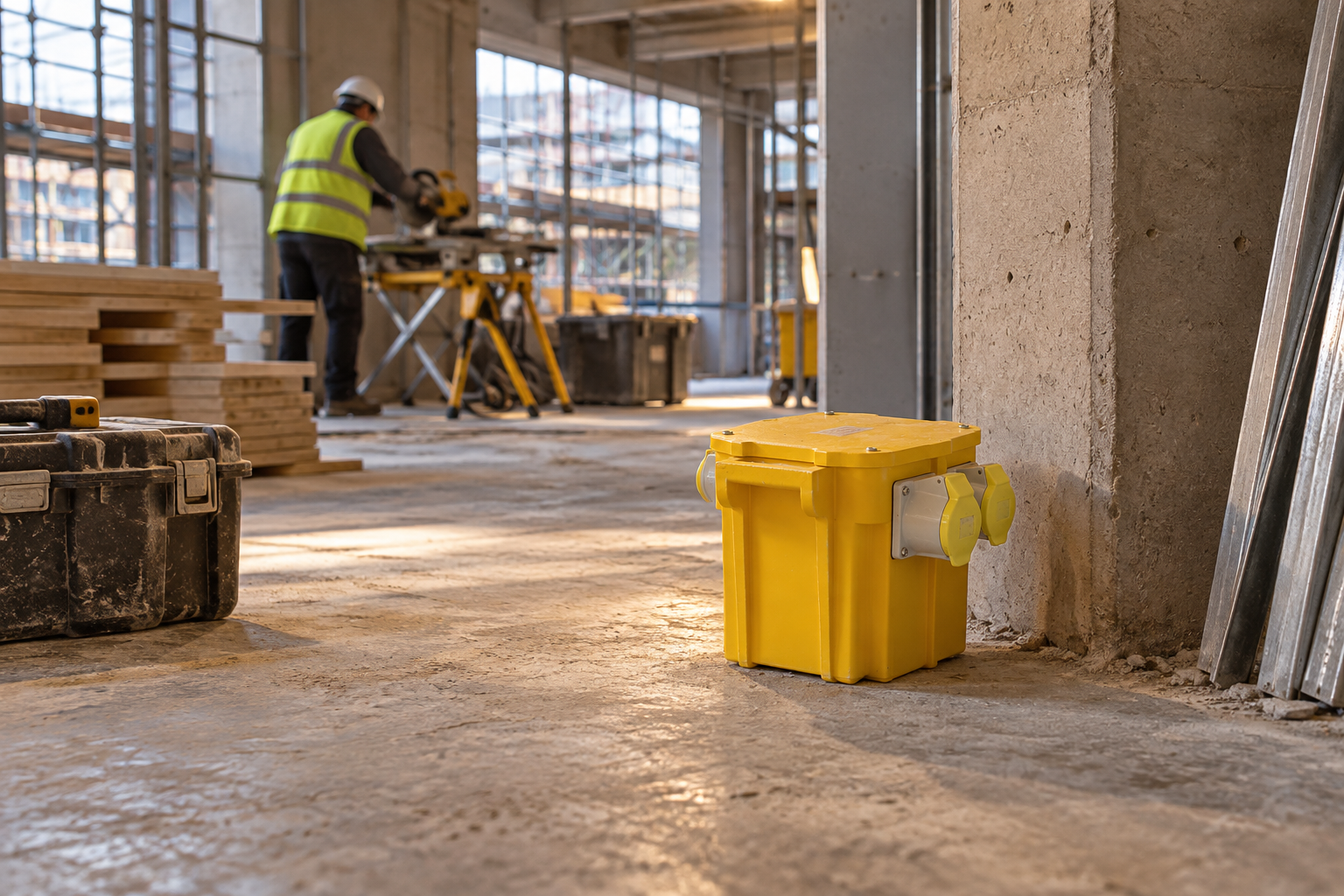
The 5.0kVA 110V Site Transformer, V901-503, provides two 16A outlets and one 32A outlet. Its current specification gives a 5.0kVA intermittent rating and 3.0kVA continuous rating, which is an important distinction when considering the equipment being connected and how long it will be operating.
This is a good example of why product specifications matter.
The number of sockets alone doesn't tell you how much equipment can safely be powered. The available supply and combined electrical load still need to be understood.
View V901-503 5.0kVA 110V Site Transformer
Distribution: More Sockets Doesn't Mean More Capacity
The same principle applies to splitter boxes.
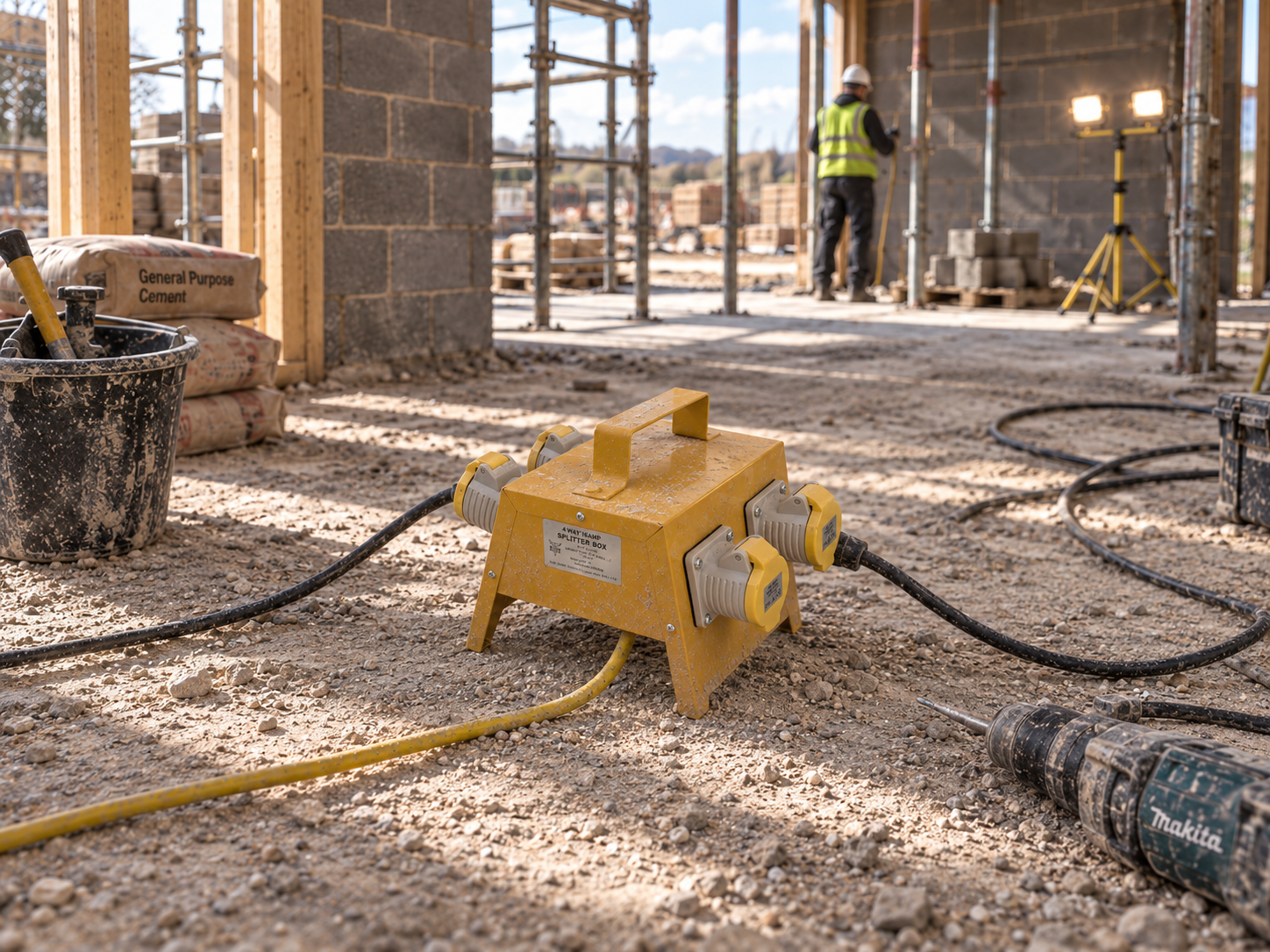
The 4-Way SiteForce Metal Splitter Box, V921-204, allows a single 16A 110V outlet to provide four 16A connection points and includes a five-metre lead.
That can make distributing power to several lights or tools much more practical.
However, adding connection points doesn't increase the capacity of the electrical supply feeding them.
That distinction is worth understanding because a convenient distribution arrangement still needs to operate within the limits of the supply, transformer and equipment involved.
View V921-204 4-Way SiteForce Splitter Box
Don't Let the Cabling Become Another Hazard
Temporary lighting often means temporary cables.
Those cable routes should be considered as part of the site setup rather than introduced afterwards.
Where leads are required, think about where people, vehicles and materials will move and whether the cable could be damaged, obstruct access or create another foreseeable hazard.
Rechargeable lighting can remove the need for a lead in some situations, but it isn't automatically better. The trade-off is between continuous electrical supply and cable management on one side, and battery runtime and charging arrangements on the other.
Choosing the right option depends on the task and environment.
What Happens if the Main Lighting Fails?
This is another area where HSE's guidance is more nuanced than simply saying every light needs a backup.
Where failure of the primary artificial lighting would itself create a risk to health or safety, HSE says emergency lighting should be provided. It gives the example of somebody working on a tower scaffold in a basement who could be unable to descend safely in darkness.
Emergency routes also need to remain sufficiently illuminated.
Where daylight provides enough light, HSE says no additional action is required. But where an escape route relies on artificial lighting, suitable emergency lighting should be available if the primary lighting fails. It only needs to provide enough illumination for people to escape safely rather than reproducing normal working light levels.
So the useful question is not "Does every light need a backup?"
It is "Where would losing this light create another significant risk?"
Common Site-Lighting Problems Worth Checking
Even an established lighting setup can become unsuitable as a project changes.
Some of the most useful things to look for are: relying on a single powerful directional source for a large area; concentrating only on lumen output rather than distribution; glare and deep shadow; access routes receiving less consideration than the workface; tall plant or stored materials blocking existing lights; headtorches being relied upon instead of area lighting; cables crossing routes where they could be damaged or become an obstruction; additional splitter boxes being added without considering electrical load; rechargeable units without a charging plan; and emergency routes dependent on a single vulnerable light source.
Construction sites aren't static.
Walls go up, scaffolding moves, routes change, equipment is relocated and natural light can disappear from an area that previously received plenty of it.
The lighting arrangement needs to be reviewed as the site changes too.
A Practical Reduced-Daylight Lighting Review
Before daylight reduces significantly, walk the site during the periods when artificial lighting is actually likely to be needed. Review access routes, loading areas, workfaces, stairs, enclosed spaces and temporary rooms; identify the type of illumination required in each area; check for glare and shadows; confirm the available electrical supply and transformer capacity; review leads, connectors and distribution equipment; check battery runtime and charging arrangements for rechargeable lights; consider the impact of equipment and materials on light distribution; confirm what happens if an important source fails; and replace or repair unsuitable equipment before it becomes relied upon.
Doing that review at midday won't necessarily tell you what the site will look like during a 7am start or towards the end of an afternoon shift.
The Right Setup Is Usually a Combination
One of the most useful lessons when planning site lighting is that different problems require different formats.
A corridor might benefit from festoon lighting. A large enclosed room may need broader globe or uplighting. A changing workface can require portable task lighting. Mobile inspection work may benefit from a headtorch. Behind all of them may sit transformers, leads and distribution equipment needed to make the arrangement work.
None of those products, on its own, makes a site compliant.
They are tools that can help businesses put an appropriate lighting and electrical arrangement into practice. The site's risk assessment, the work being undertaken, installation, positioning, electrical capacity, inspection and ongoing management all remain important.
That is ultimately what HSE's guidance points towards: site lighting should be planned around how people actually work and move through the environment, not simply around how many lights have been installed.
Need Help Choosing the Right Site-Lighting Setup?
FixFirm supplies lighting and site-electrical equipment for a wide range of construction and trade applications, from festoon and portable work lights through to transformers, leads and distribution equipment.
If you're reviewing an existing setup or planning lighting for a larger project, the FixFirm team can help you compare the practical options for different work areas and power requirements.
View FixFirm's wide range of Site Electrics & Lighting products, or speak to the team about the right setup for larger or more complex site requirements.
Further HSE Guidance
- HSE: Site Lighting
Covers construction-site lighting, shadows, safety signs, emergency lighting and escape routes. - HSE: Lighting at Work (HSG38)
Covers lighting risk assessment, good practice and recommended illumination levels. - HSE: Electrical Safety on Construction Sites (HSG141)
Covers temporary electrical systems, equipment selection and electrical risk management on construction sites. The current edition was published in 2023. - HSE: Workplace Transport - Lighting
Covers lighting around roads, yards, manoeuvring areas, pedestrian routes and vehicle movements, including positioning lights to reduce glare and shadow.